Every driver knows that even the smallest stone chip or light brush against a branch can ruin a car’s paint finish. Over time, exposure to road debris, UV light, and physical contact leaves visible marks. The modern solution — Paint Protection Film (PPF) — acts as a silent defender against these threats. But what exactly makes it so resistant to scratches and impact?
At KD Auto Detailing, understanding the science behind paint protection film is more than a service skill — it’s an exploration into material engineering. The durability of PPF isn’t magic; it’s a combination of chemistry, physics, and modern manufacturing techniques. Let’s break down what truly gives this film its resilience and ability to heal itself after damage.
Understanding the Purpose of Paint Protection Film
Why Vehicle Surfaces Need Added Protection
A vehicle’s paint faces constant stress from mechanical abrasion, UV rays, and chemical contaminants. Even light contact from sand or gravel can cause micro-abrasions that dull the surface. Over time, this weakens the paint’s clear coat and reduces its reflective quality.
Paint Protection Film Adelaide acts as a sacrificial shield. It absorbs these small impacts and abrasions, ensuring that the paint underneath remains untouched. This layer essentially becomes a transparent armor, protecting the surface without changing its appearance.
How Paint Protection Film Works as a Barrier
The film doesn’t just block physical damage — it also prevents environmental degradation. The polymer surface repels water, dirt, and oils, minimizing the buildup of contaminants that could etch into the paint.
PPF’s unique elasticity allows it to expand and contract with temperature changes, preventing cracking or peeling. This flexibility ensures that the film adapts seamlessly to the vehicle’s contours while maintaining its structural integrity.
The Science Behind Scratch Resistance
The Role of Thermoplastic Urethane (TPU)
At the heart of modern Paint Protection Film is thermoplastic polyurethane (TPU) — a flexible, elastic polymer known for its strength and self-repairing properties. TPU combines both softness (which absorbs energy) and toughness (which resists deformation).
This dual characteristic allows TPU-based films to recover from scratches and minor abrasions when exposed to mild heat, such as sunlight or warm water. The molecular bonds reorient themselves, effectively “healing” surface imperfections without external intervention.
How Elastic Recovery Prevents Surface Damage
When a film is stretched or dented, elastic recovery comes into play. The TPU’s molecular chains realign to their original structure after deformation, restoring smoothness. This is why light scratches or swirl marks often vanish after a few hours under sunlight.
Elastic recovery also means that PPF doesn’t tear easily upon contact with small debris. Instead, it disperses impact energy across a wider area, preventing concentrated damage.
The Multi-Layered Structure of Paint Protection Film
The Top Coat: The Self-Healing Surface
The topmost layer of a high-quality PPF is engineered to be hydrophobic and self-healing. This surface contains elastomeric polymers that rearrange under heat, closing microscopic scratches.
This layer also resists UV degradation and chemical staining, ensuring long-term transparency. Without it, oxidation and fading would quickly diminish the film’s performance and appearance.
The Middle Layer: The Impact-Absorbing Core
Beneath the top coat lies the impact-absorbing TPU core — the main defense against physical stress. This layer flexes to absorb and dissipate kinetic energy from stones, insects, or debris.
Think of it as a sponge for energy. Instead of cracking or denting like hard coatings, it absorbs and spreads impact forces, drastically reducing the likelihood of permanent damage to the underlying paint.
The Adhesive Layer: Ensuring Secure Bonding
The base layer of Paint Protection Film is its adhesive — a pressure-sensitive bonding agent that connects the film to the vehicle’s clear coat. It must be strong enough to stay attached under all conditions yet gentle enough to remove without residue.
A properly engineered adhesive ensures that PPF remains bubble-free and maintains edge integrity, even under temperature swings or continuous sun exposure. Adhesive technology is vital for maintaining full contact and preventing delamination.
How Paint Protection Film Resists Physical Impact
Energy Distribution and Shock Absorption Mechanism
When an object strikes the surface, the PPF’s layered construction spreads the energy laterally instead of allowing it to focus on one point. This diffusion minimizes surface indentation.
This mechanism is similar to how helmets absorb shocks — spreading energy across a larger surface reduces the damage potential. For PPF, this translates to fewer chips and dents, even after years of exposure to road grit.
How Surface Flexibility Reduces Dent Propagation
The elasticity of TPU means it bends rather than cracks under pressure. This prevents small impacts from turning into visible dents.
Flexible films maintain surface integrity even when the underlying paint layer expands or contracts due to heat. This dynamic adaptability is one of the reasons PPF performs so well in varying climates.
The Role of Nanotechnology in Scratch Prevention
How Nano-Scale Coating Densities Increase Durability
Modern Paint Protection Films incorporate nanostructured coatings that fill molecular gaps, creating a dense, smooth surface. This minimizes friction and reduces the chances of scratching from physical contact.
These nano-coatings make the film harder to penetrate without compromising flexibility. In essence, nanotechnology creates an invisible microscopic armor that reinforces the outermost layer of the film.
UV Stability and Oxidation Resistance in Nanostructures
UV rays cause molecular breakdown over time, leading to yellowing or hardening of older films. Nano-engineered UV stabilizers prevent this by reflecting or absorbing harmful radiation before it penetrates the deeper layers.
This enhanced UV resistance helps maintain optical clarity, ensuring that the film stays virtually invisible on the paint surface for years. It also slows oxidation, preventing the film from becoming brittle.
Environmental Conditions That Affect PPF Performance
Temperature Fluctuations and Their Effect on Coating Behavior
PPF must perform consistently in both cold and hot environments. Temperature swings cause materials to expand and contract, which can create tension in lower-quality films.
High-grade TPU films manage this through thermal stability — maintaining elasticity even in sub-zero temperatures while softening slightly in heat to self-heal micro-scratches. This adaptability ensures long-term resilience.
The Impact of Humidity, Dust, and Road Debris
Humidity introduces moisture that can seep into microscopic pores if the adhesive or surface layer isn’t sealed properly. Advanced PPF materials are designed to resist water absorption, maintaining their bond and preventing edge lifting.
Similarly, road debris and dust abrasion are deflected or cushioned by the film’s upper layers. This passive defense helps vehicles retain a cleaner, smoother finish with minimal external degradation.
The Importance of Material Engineering and Polymer Science
Cross-Linking Density and Polymer Chain Behavior
Cross-linking in polymers defines how tightly molecular chains are bonded. In PPF, higher cross-linking density increases toughness without sacrificing flexibility.
These microscopic bonds distribute stress evenly when the film encounters sharp or abrasive contact, resisting cuts and punctures while maintaining transparency.
The Relationship Between Hardness and Flexibility
Contrary to popular belief, harder isn’t always better. Paint Protection Film relies on a balance — too hard, and it cracks; too soft, and it dents.
The ideal formulation keeps surface hardness moderate while maintaining elasticity. This combination lets the film flex under pressure yet remain durable enough to recover from scratches.
How KD Auto Detailing Analyzes Film Durability in Real Conditions
Observing Scratch Resistance Under Real-World Stress
At KD Auto Detailing, technicians frequently test how Paint Protection Films respond to real environmental challenges. Factors like road grit, washing friction, and UV exposure reveal how molecular integrity holds over time.
By observing these behaviors, professionals can understand the balance between chemical structure and mechanical performance — ensuring the film truly behaves as designed under daily stress.
The Long-Term Behavior of Paint Protection Film Under Daily Use
Long-term observation shows that well-engineered films maintain elasticity and gloss even after years of exposure. Small scratches fade naturally, and impacts rarely breach the top layer.
Data gathered from these real-world studies helps improve understanding of wear mechanisms — supporting continuous advancements in film manufacturing and installation practices.
The Future of Scratch-Resistant Paint Protection Films
New Developments in Self-Healing Technologies
Future PPF formulations are exploring self-healing polymers that respond to both heat and mechanical stress simultaneously. These next-generation coatings can repair themselves faster, even in colder conditions.
Research also points to coatings with “shape memory” — the ability to return to an exact surface geometry after deformation, extending both durability and lifespan.
Advances in Impact-Responsive and Smart Materials
Smart coatings may soon react actively to impact, stiffening instantly upon contact to absorb energy more efficiently. Some experimental films even use embedded nanocapsules that release healing agents when punctured.
These innovations will allow future Paint Protection Films to adapt dynamically to real-time stress, pushing automotive surface protection toward intelligent design.
Navigate from Holden Hill to KD Auto Detailing Now
What Makes Paint Protection Film Resistant to Scratches and Impact?
Material Composition:
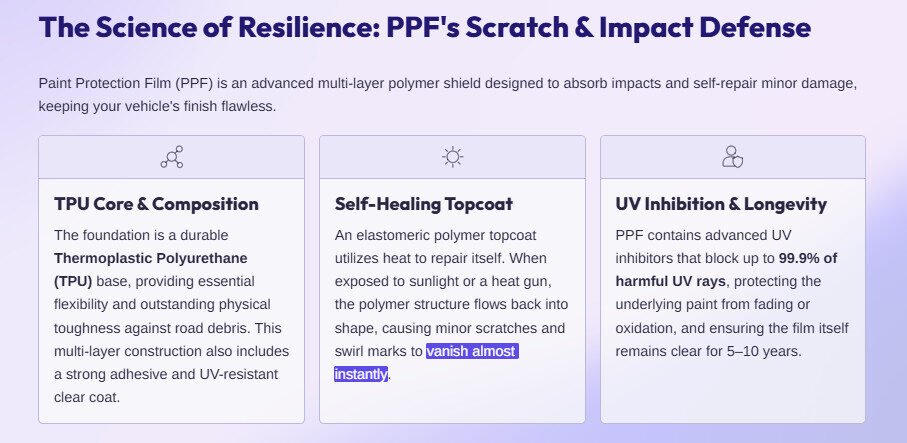
- Thermoplastic Polyurethane (TPU) base provides flexibility and toughness
- Multi-layer construction includes adhesive, protective topcoat, and UV inhibitors
Thickness & Protection Levels:
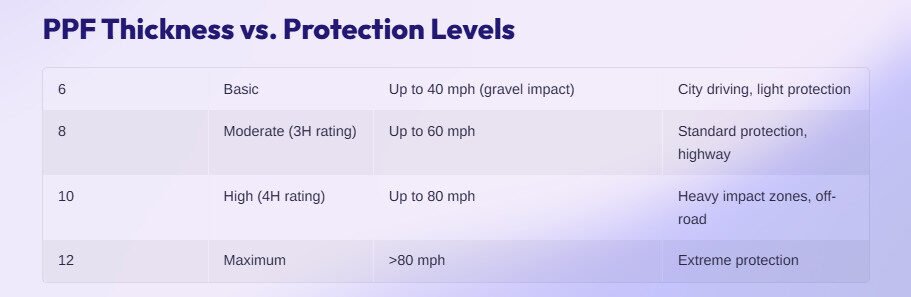
- Thickness (mils) Scratch Resistance Impact Resistance (mph gravel impact) Typical Use Case 6 Basic Up to 40 City driving, light protection 8 Moderate (3H rating) Up to 60 Standard protection, highway 10 High (4H rating) Up to 80 Heavy impact zones, off-road 12 Maximum >80 Extreme protection
Self-Healing Technology:
- Minor scratches disappear with heat exposure (sunlight or heat gun)
- Enables long-term surface clarity and durability
Lab-Tested Impact Resistance:
- Gravel impact tests simulate 10-second bombardment at controlled speeds
- 8-mil films withstand impacts up to 60 mph without damage
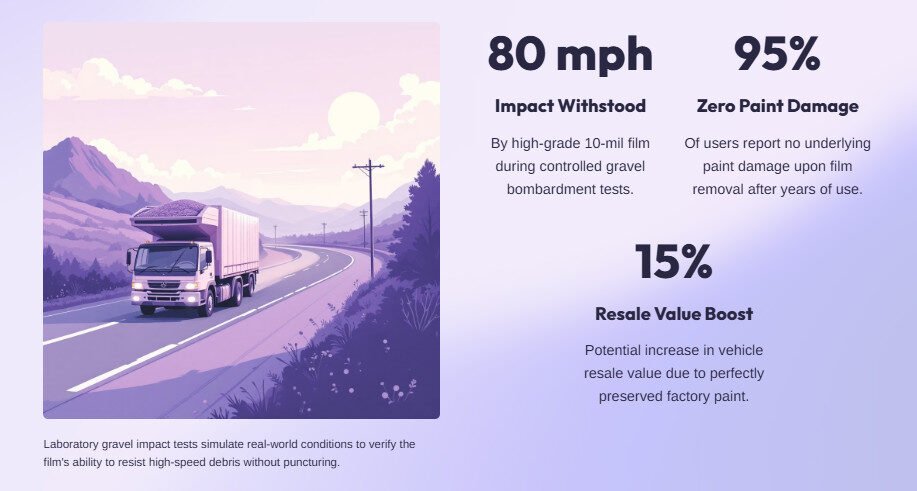
- 10-mil films withstand impacts up to 80 mph, protecting paint beneath
UV Protection & Longevity:
- Advanced UV inhibitors block 99.9% of harmful rays
- Maintains clarity and prevents yellowing for 5–10 years with proper care
Real-World Benefits:
- Over 95% of users report no paint damage after PPF removal
- Vehicles with PPF retain up to 15% higher resale value due to preserved paint
Sources: Garvin Auto Spa (2025), Car Specialist Customs (2024), ID Protection Lab Tests (2025), Scientific Studies on Automotive Clearcoats (Noh, 2018)
The ability of Paint Protection Film to resist scratches and impact isn’t luck — it’s precision science. Every layer, from the adhesive base to the self-healing topcoat, is designed to absorb, distribute, and recover from physical stress.
Through advanced polymer engineering, nanotechnology, and field testing, films continue to evolve. For professionals like KD Auto Detailing, understanding these mechanisms isn’t just about protecting cars — it’s about exploring the intersection of chemistry and performance in automotive innovation.
FAQs
How does Paint Protection Film repair itself after scratches?
It uses elastomeric polymers that realign under heat, closing surface marks and restoring smoothness.
What makes TPU ideal for impact resistance?
TPU’s flexible molecular chains absorb and disperse energy, preventing damage concentration.
Can Paint Protection Film resist deep scratches?
It resists light to moderate scratches effectively, but deeper cuts may require replacement of the affected section.
How long does Paint Protection Film maintain its properties?
High-quality PPF can retain optical clarity and elasticity for several years with proper maintenance.
Does temperature affect PPF performance?
Yes, but premium films are engineered to remain stable across a wide range of temperatures, allowing flexibility and self-healing even under extreme conditions.